

 English
 Danish
 French
 Swedish
 Vietnamese
 Spanish
 German
 Polish
 English




How to Design a Feed Mill
Key Considerations for an Efficient Feed Production Plant
Designing a feed mill is much more than selecting a grinder, mixer and a few storage bins. A well-designed feed mill is a complete production system where raw materials, equipment, capacity, process flow, automation, feed quality and future expansion all need to work together.
Whether the project is a small on-farm feed mill or a large industrial plant, the same principle applies: start with the production requirements and design the process around them – not the other way around.
A good feed mill design should provide efficient production, consistent feed quality, easy operation and the flexibility to adapt as production requirements change.
1. Start with the purpose of the feed mill
The first step is to define what the feed mill needs to achieve.
The required capacity is important, but it is only one part of the equation. The design also depends on the type of animals being fed, the number of feed recipes, the raw materials available and whether the feed will be produced as meal or pellets.
For example, a feed mill producing a few different feed types for one livestock operation will have different requirements from an industrial plant producing many recipes every day.
Key questions include:
- How many tonnes of feed need to be produced per year?
- What peak production capacity is required?
- Which animal species and production stages will the feed cover?
- How many different recipes will be produced?
- Which raw materials will be used?
- Will the feed be produced as meal, pellets or both?
- How much automation is required?
- Is future expansion likely?
These questions form the basis for the entire feed mill design.
2. Design the process flow before choosing the equipment
A feed mill should be designed as one connected process.
A typical process can include:
Raw material intake → cleaning → storage → dosing → grinding → mixing → pelleting → cooling and screening → finished feed storage → distribution
Not every feed mill requires all these processes, but the material flow should be considered from the beginning.
The aim is to create a logical flow with as little unnecessary transport, handling and waiting time as possible. FAO describes the main feed manufacturing processes as including receiving, processing, storage and distribution, with grinding, mixing and pelleting forming key processing stages.
This is also where the interaction between the different machines becomes important. A high-capacity grinder is of little benefit if the dosing, conveying or mixing system cannot keep up.
The feed mill should therefore be designed as a system – not as a collection of individual machines.
3. Choose the right feed mill layout
One of the fundamental design decisions is whether to build the feed mill vertically or horizontally.
A vertical feed mill places processing equipment in different levels, allowing gravity to move materials through parts of the process. A horizontal design places as much equipment as possible on one floor.
Both principles can work, but the right solution depends on the specific project, building, site and capacity.
For many projects, a horizontal layout can offer practical advantages. Working mainly on one level can make access, maintenance and material handling easier, while avoiding the need for a tall building can reduce construction complexity and cost.
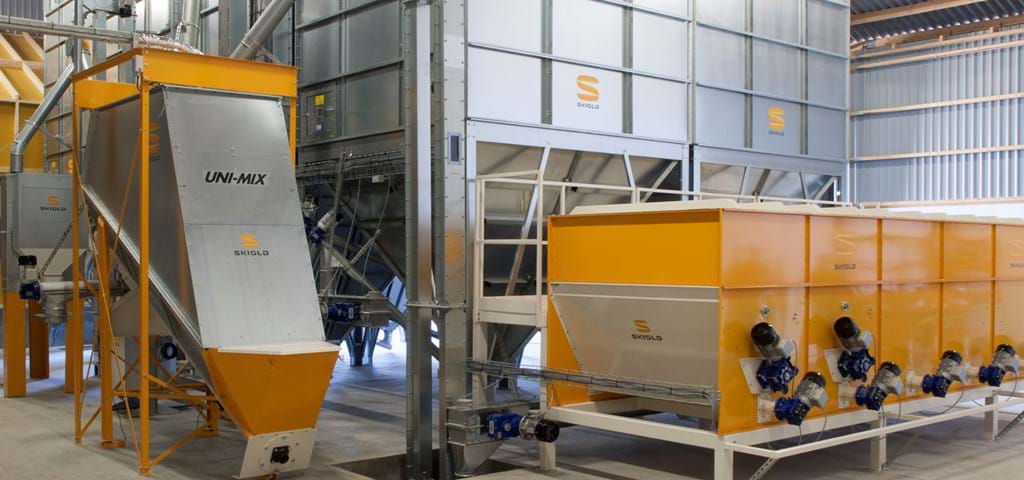
Based on its experience designing feed mills around the world, SKIOLD primarily uses horizontal designs where they provide the most efficient solution for the customer. The company has designed feed mills ranging from small farm plants to installations in the 30–40 tonnes-per-hour range.
The layout should also provide sufficient space around critical equipment for inspection, cleaning, maintenance and future modifications.
4. Plan raw material intake and storage carefully
Raw material handling is one of the foundations of an efficient feed mill.
The system needs to accommodate the types and quantities of raw materials used in production, including cereals, protein sources, minerals, premixes and potentially liquid ingredients.
Storage capacity should be based not only on average consumption but also on purchasing patterns, delivery logistics and the desired level of security of supply.
Good storage design also supports feed quality. Raw materials should be protected from moisture, contamination and deterioration, while systems such as temperature monitoring can help identify problems in stored grain.
In a complete feed mill, intake and storage should therefore be considered together with the production process. A well-designed system can allow several operations – such as intake, drying, storage and feed production – to take place without unnecessarily delaying one another. This approach is used in SKIOLD installations where flexible transport routes are designed to allow processes to run simultaneously.
5. Select grinding technology based on the feed requirement
Grinding has a direct influence on feed structure, energy consumption and the subsequent mixing or pelleting process.
The right grinding technology depends on the raw materials and the required particle size. Hammer mills, disc mills and crushers can all have a role in feed production, depending on the application.
For pigs and poultry, hammer mills and disc mills are commonly used, while crushers or disc mills may be suitable for cattle and other ruminant feeds.
The objective should not simply be to achieve the highest grinding capacity. The grinding system should deliver the required feed structure efficiently and consistently.
It is therefore important to consider:
- Required particle size and feed structure
- Raw material characteristics
- Required capacity
- Energy consumption
- Flexibility between different feed types
- Maintenance and wear
- Integration with dosing and mixing
The grinding system should be sized as part of the complete process rather than independently.
6. Get dosing and mixing right
Accurate dosing is essential when producing consistent feed.
Different ingredients need to be weighed and added according to the recipe, from major raw materials to minerals, premixes and other micro-ingredients. The dosing system must therefore match the number of recipes, required accuracy and production capacity.
The mixer then needs to distribute these ingredients evenly throughout the batch.
According to FAO, feed manufacturing involves both premixing of micronutrients and the subsequent mixing of the complete diet. The design of the mixing process therefore has a direct relationship with the consistency of the finished feed.
The choice of mixer depends on the raw materials, batch size, mixing accuracy and required production rate. SKIOLD, for example, offers different mixer technologies for different applications, including horizontal, inclined, paddle and small-batch mixers.
For a complete feed mill, dosing and mixing capacity must be balanced with grinding and conveying capacity. Otherwise, the mixer can become a bottleneck in the production line.
7. Consider pelleting as part of the overall design
If the feed is to be pelleted, pelleting should be considered from the early design stages.
Pelleting adds several processing steps, including conditioning, pellet pressing, cooling and often screening. The required capacity and product specifications influence the size and configuration of the entire downstream system.
The pelleting line must therefore be matched to the production capacity upstream. Grinding, dosing and mixing need to supply the pelleting system at the required rate, while cooling, screening and finished feed handling must be able to process the output.
The same principle applies here: capacity is only useful when all parts of the process are balanced.
8. Use automation to connect the entire process
Modern feed mills can automate a large part of the production process, from dosing and grinding to mixing, pelleting and finished feed handling.
Automation is not simply about reducing manual work. It can also provide better process control, repeatability, documentation and traceability.
A digital control system can manage recipes, batch sequences and material flows while providing operators with an overview of production.
Traceability should also be considered during the design phase. SKIOLD points out that achieving full traceability requires the physical feed mill to be designed accordingly, including the ability to identify incoming material lots and follow them through the production process.
This is an important point: traceability cannot simply be added to a feed mill at the end of the project.
9. Design for safety, hygiene and maintenance
A feed mill must be designed for reliable operation – but also for safe and practical daily use.
Access to equipment should be considered during the design phase, including inspection, cleaning, servicing and replacement of wearing parts.
The layout should also support good housekeeping and minimise the risk of contamination.
FAO's guidance on feed manufacturing highlights the importance of facility design, ingredient storage and handling, cleanliness, worker safety and maintenance as integral parts of a feed manufacturing facility.
These considerations are sometimes overlooked when the main focus is on production capacity. However, difficult access to equipment or inefficient cleaning routines can have a significant impact on the long-term performance of the plant.
10. Design for today – but allow for tomorrow
A feed mill is a long-term investment. Production requirements can change, and the plant should ideally be able to develop with the business.
Future-proofing can include:
- Space for additional storage
- Extra dosing or premix systems
- Additional grinding or mixing capacity
- Expansion of the pelleting line
- More finished-feed storage
- Additional recipes or animal groups
- Increased automation
- A second production line
This does not necessarily mean building a larger plant than needed from day one. Instead, the design should identify where future expansion is technically and economically realistic.
For larger capacities, for example, SKIOLD describes solutions where a basic production line can be expanded with a parallel line, while common intake and other upstream functions can continue to serve both lines.
A good feed mill design starts with the whole picture
Designing a feed mill successfully requires more than choosing the right individual machines.
The best solution comes from understanding the complete production process and balancing:
Capacity + raw materials + feed recipes + grinding + dosing + mixing + storage + automation + quality + future expansion
When these elements are designed together, the result can be a feed mill that is easier to operate, more efficient to maintain and better prepared for future requirements.
SKIOLD designs complete feed milling solutions for farms and feed producers worldwide, from smaller on-farm installations to large industrial plants. The solutions can include raw material intake, cleaning, storage, conveying, dosing, grinding, mixing, pelleting, finished feed handling and digital control.
Planning a new feed mill or upgrading an existing plant?
The right design depends on your raw materials, production targets, feed types and future plans. A detailed analysis of these requirements is the first step towards a feed mill that delivers the right capacity, flexibility and cost efficiency.
[Talk to SKIOLD about your feed mill project →]
References & further reading
- FAO – Feed Milling Processes
Food and Agriculture Organization of the United Nations. Technical information covering material flow, grinding, mixing, pelleting, cooling, screening and feed mill processes.
FAO – Feed Milling Processes - European Commission – Feed Hygiene
Official EU information on feed hygiene, feed business operators, traceability and good practices for feed production.
European Commission – Feed Hygiene - European Union – Regulation (EC) No 183/2005 on Feed Hygiene
Official EU legislation covering feed hygiene, traceability and requirements for feed business operators.
EUR-Lex – Regulation (EC) No 183/2005 - FEFAC – European Feed Manufacturers' Guide (EFMC)
Guide to good manufacturing practices for the industrial production of compound feed and premixtures, including feed safety and HACCP principles.
FEFAC – European Feed Manufacturers' Guide


